

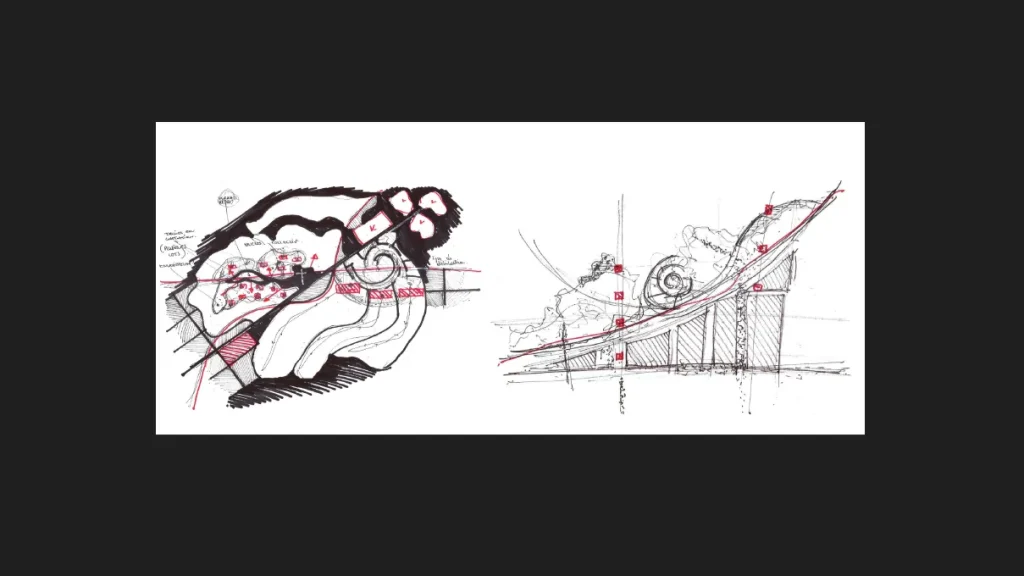
La Fontaine made animals full-fledged characters. How, today, can much of the reflections and knowledge brought about by philosophy, ethology and cognitive sciences be put into practice, without going so far as fabulation?
There is no longer a question of considering the animal as the mirror of ourselves, but of considering it for itself and of bearing interests that it cannot defend. This, let us recall, does not imply placing it at the same level as the human being or treating it in the same way. It is a question of developing a reflection on our relationship to non-human living beings, in a context where the right to dispose of the life of others raises questions, through the prism of architecture. What needs to be reconsidered « architecture » when it is no longer a matter of designing, by definition, for human beings, but for a living species « Non-human ».
A world that is not absurd
Their world has neither the same texture nor the same thickness as ours. Their senses have access to things that are inaccessible to us. The animal being a sense interpreter, its needs are physical and psychological; One could even go so far as to say semiotics, since he continually seeks to give meaning to what he perceives and feels. He must therefore be able to live in a world that is not absurd to him.
What architectural invention?
Taking into account all these elements, what would be the architectural invention? What medium should she be charged with? Should architecture, and can it, merge with environments or establish them?
This category of non-human living should no longer be excluded or bypassed in the thought of these shared places. And perhaps to consider it, one must dare to fall into a certain theoretical fiction, if only to give to think and open new ways profitable to all.